Redefining set capture for shows like The Neighbors, Frasier, and NCIS
Paramount CBS and Volinga collaborated on a groundbreaking proof of concept exploring how Gaussian Splat technology could capture, preserve, and reuse television sets with cinematic accuracy. The project tested Volinga’s capabilities across multiple shows, including The Neighbors, Frasier, and NCIS, to demonstrate how AI-driven environment capture can streamline production, reduce costs, and enable creative flexibility.
Challenge
Television productions face a common and costly challenge: once sets are struck, reshoots or promotional shoots often require rebuilding them from scratch. Traditional 3D scanning tools like LiDAR or photogrammetry can be slow, costly, and not color-accurate enough for ICVFX. CBS’s Virtual Production team sought a faster, production-ready way to digitally capture sets with true-to-life fidelity, from lighting to color space, that could be instantly usable on LED walls or in virtual production environments.
“What used to take months to rebuild can now appear overnight on an LED wall. That’s game-changing.”
– Brian Vogt, VFX Supervisor, CBS VFX
Proof of Concept
When CBS VFX and Volinga first began their collaboration, the goal was simple but ambitious: to prove that AI-driven Gaussian Splats could capture and reproduce real television sets with broadcast-level fidelity.
What started as a technical experiment quickly evolved into a pipeline, beginning at early proof-of-concept tests to full-scale, production-ready workflows. Each stage of testing built upon the last, advancing both the creative and technical potential of real-time 3D set capture.
Together, the teams explored how color accuracy, camera integration, and professional-grade pipelines could transform how television environments are captured, preserved, and reused.
The CBS VFX team used a series of sets to capture and test their methodology.
PoC #1: The Neighbors – Dominating Color in Gaussian Splats
When Paramount first approached Volinga, the goal wasn’t just to test another virtual production tool. It was to see if real-time 3D capture could truly meet the standards of broadcast television.
The pilot project began with The Neighbors, a simple yet revealing proof of concept. The set, a kitchen, couch, and dining area, was chosen for its natural lighting and warm tones, perfect for testing how Volinga’s Gaussian Splat technology handled color.
Working hand in hand, Volinga and Paramount Virtual Production team set out to match the color fidelity of the show’s own ARRI Alexa 35 footage. The results were striking: accurate skin tones, consistent lighting, and smooth parallax that held up even under television scrutiny.
For Paramount, it was the first sign that splats weren’t just for previs. They could hold their own in production. See below for a test shot in front of the splat.
Encouraged by the results from The Neighbors, the next challenge was a bigger one: recreating the iconic Frasier set, complete with piano, city backdrop, and signature warm tones. For this test, Paramount aligned the capture and production cameras, both using the ARRI Alexa 35, ensuring identical color pipelines. The footage was processed in ACES, producing linear EXRs that could be directly compared side-by-side with the live footage.
The experiment paid off. The splat renders were visually indistinguishable from the on-set shots with seamless color matching, correct exposure, and the right cinematic “feel.”
Though the captured set didn’t make it to air, it demonstrated that Volinga’s process could achieve television-ready results in real-time 3D, a major leap from the previs-quality captures of earlier workflows.
Can you guess which shot is a splat and which is the actual set?
If you guessed the right is the splat, you are correct!
PoC 3: NCIS – Mastering the Splats
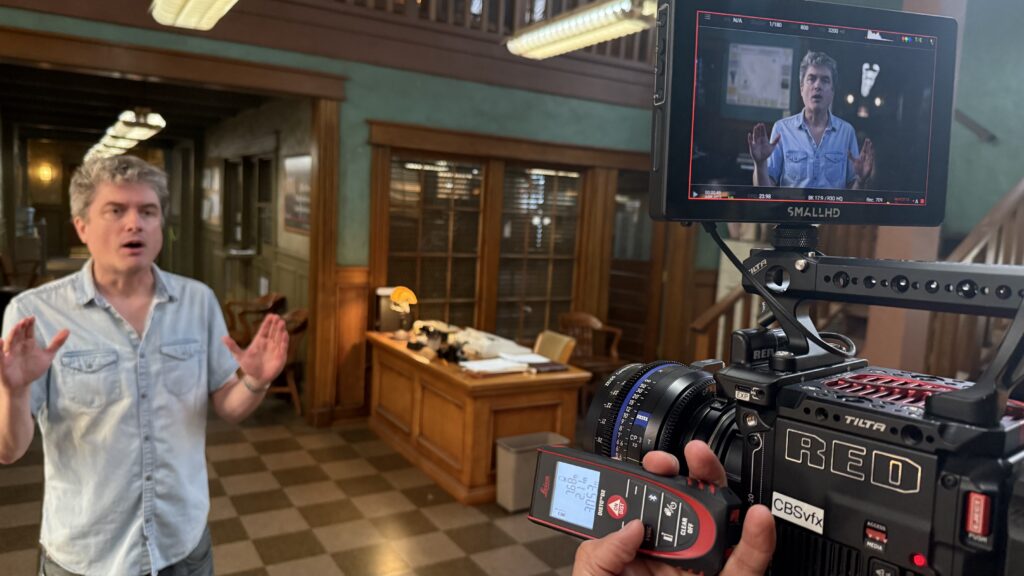
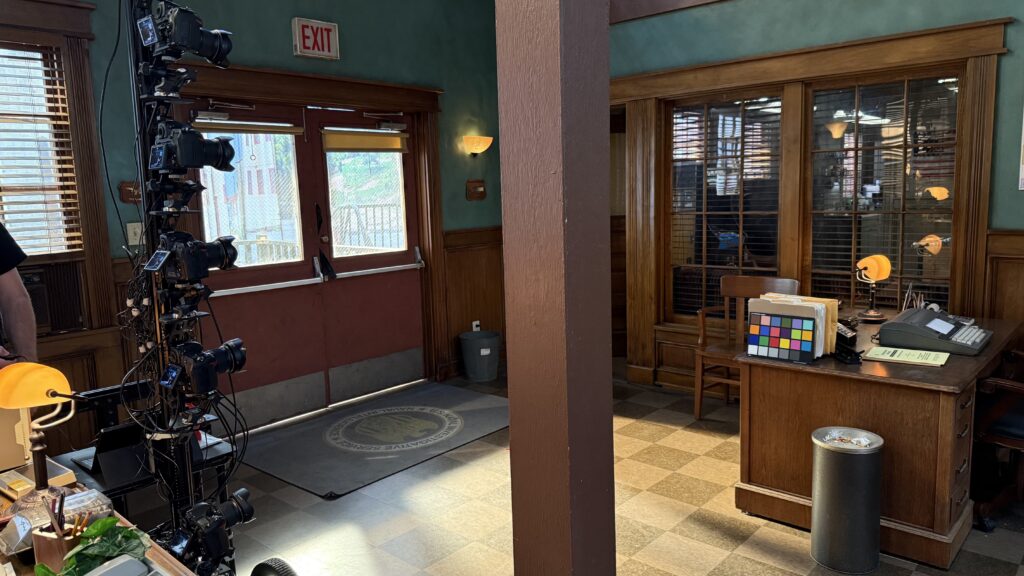
The next frontier was NCIS, where the goal was to test custom capture rigs and a professional-grade color pipeline capable of matching different camera systems.
Using a multi-camera rig of five Nikon D850s, the team captured the NCIS set in ultra-high resolution RAW. The challenge was to match the color output of the RED Raptor, the show’s production camera, a notoriously difficult color space to replicate.
Paramount’s team developed a custom workflow using ColorClone, an AI-based color transform tool. By training it on real images shot with both camera systems, they created a precise Nikon-to-RED conversion within the ACES framework. The result: a perfect color match across dynamic ranges, producing linear EXRs indistinguishable from the show’s own footage.
Workflow Innovation
On-Set Integration: Proxy data was uploaded to Volinga servers during shooting, allowing real-time feedback and corrections before wrap.
Color Accuracy: Volinga’s ACES-managed pipeline and Alexa color-space matching ensured identical results between real and virtual cameras.
Cross-Department Collaboration: Production Design, Camera, and VFX teams worked together seamlessly to strategize capture, avoid reflective surfaces, and validate results.
“Color fidelity is critical for ICVFX. It needs to be accurate. Volinga’s pipeline made it predictable, repeatable, and production-ready.”
The early proof of concepts revealed key challenges and valuable learnings. Initial tests exposed the extreme sensitivity of color pipelines, where even minor mismatches proved unacceptable for on-air broadcast standards. Achieving perfect parity demanded close collaboration between the camera, color, and VFX teams, ensuring every element aligned with the creative and technical vision. Adopting new AI-driven tools also required an open, experimental mindset, one defined by “riding the waves of failure and success” as the teams collectively pushed the boundaries of what’s possible in modern television production.
Future Outlook
CBS VFX now envisions building a Virtual Backlot, a growing library of high-fidelity, color-accurate 3D environments captured with Volinga. The success of this proof of concept validates that Gaussian Splats can be production-grade, not just previs, and opens the door to a more sustainable, efficient future for television production.
“This is exactly the kind of future-forward technology CBS VFX wants to champion, the use of AI and real-time tools to transform how we make television.”