
How 3D Gaussian Splatting Will Reshape Previs and Production Design
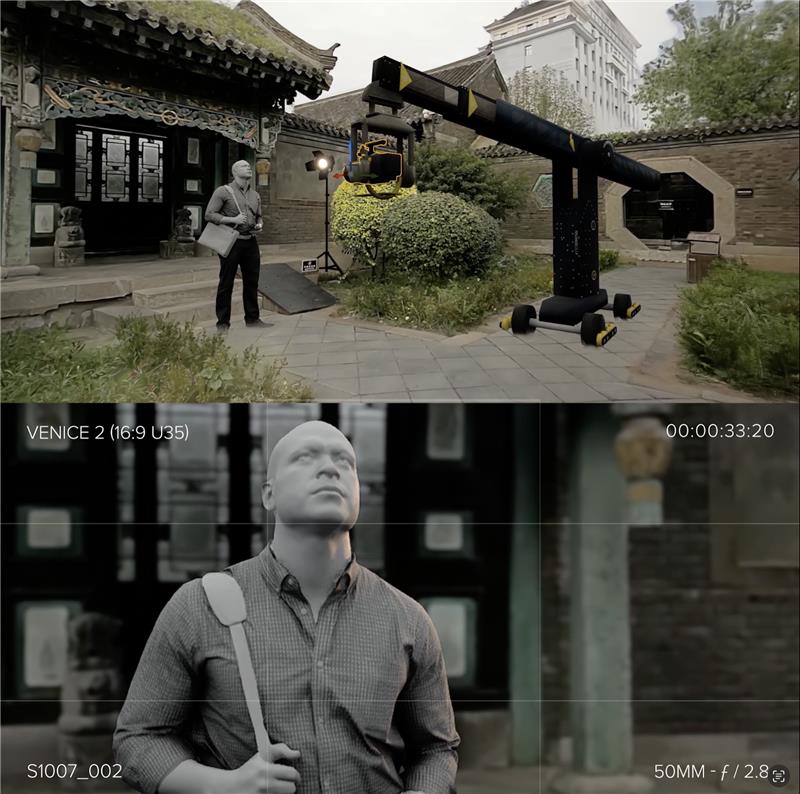
A few days ago, Epic Games published a spotlight on how real-time visualization workflows helped tackle complex sequences on Sinners — not just as a traditional deliverable, but as a shared creative space where departments could iterate, align, and de-risk decisions early.
That’s the core promise of previsualization: make decisions when they’re still cheap.
Real-time engines have already transformed previs by enabling faster creative iteration, higher fidelity visualization, better cross‑department alignment, and reduced risk before physical production begins.
Now, 3D Gaussian Splatting (3DGS) is entering serious virtual pre-production workflows — dramatically lowering the time and cost of bringing real locations into previs-ready environments.
A timely example: gaussian splatting supported visualization workflows for Jurassic World Rebirth, enabling teams to explore scale, framing, and spatial design earlier in the pipeline.
Let’s unpack why this matters.
At its simplest, previs is the process of visualizing the film before you shoot it. It allows filmmakers to explore blocking, camera movement, lensing, editorial rhythm, choreography, and spatial design before stepping onto set. In practice, it means the team can “watch the movie before making the movie,” aligning creative and technical intent early, when changes are still inexpensive and flexible.
If you need a quick refresher on the fundamentals, this short explainer on previs provides a helpful overview.
What fundamentally changed with real-time engines like Unreal Engine was not just speed, but the quality of iteration. Instead of exporting static previs sequences that quickly become outdated, teams can now work inside living scenes. Lighting updates instantly. Cameras behave cinematically. Directors can test alternatives in real time. Departments can collaborate around a shared, evolving digital environment.
Epic’s deep dive on how game engines elevated previs illustrates this shift clearly.
Previs stopped being a one-off artifact delivered at the end of a phase. It became a dynamic decision-making environment that can evolve alongside the production.
But there’s still one major bottleneck.

Previs is only as strong as the 3D environment inside it.
And this is where many pipelines struggle — especially when previs evolves into Techvis. Techvis requires physically accurate measurements, reliable scale, camera clearance validation, crane and rig footprint checks, and overall real-world feasibility validation.
Traditional 3D environment creation usually involves LiDAR or photogrammetry capture followed by heavy mesh cleanup, retopology, UV mapping, optimization, and lookdev. That process is slow, expensive, and often excessive for early creative decision-making.
When the goal is iteration, traditional asset pipelines become friction.
This is precisely where 3D Gaussian Splatting starts to change the equation.
3D Gaussian Splatting enables teams to create digital replicas of real‑world environments up to 10× faster compared to traditional 3D asset workflows. Instead of rebuilding reality from scratch, you capture it directly, which dramatically reduces friction during pre‑production and makes earlier creative iteration far more practical.
A good example is the virtual pre‑production workflow developed by District Cinema, described in this case study. Their approach combines rapid capture with real‑time visualization, allowing teams to generate digital twins — sometimes in under 30 minutes — that can be explored, relit, and used for camera planning months before stepping on location. These environments are not just visual references; they can also support Techvis‑style decisions where scale, spatial relationships, and staging matter. Some productions have reported up to 75% reductions in pre‑production time using similar workflows.
Importantly, District Cinema is not an isolated case. RCS Studios has also been incorporating 3DGS captures directly into Unreal Engine previs workflows, showing that gaussian splatting integrates naturally with established real‑time pipelines rather than replacing them. The example below shows some of their previs work inside Unreal:
RCS Studios’ team has even taken this a step further by developing their own viewer for gaussian splat environments, allowing directors, production designers, and clients to explore captured spaces without needing to be proficient in Unreal Engine. Lowering that barrier is key if 3DGS is going to become a mainstream pre‑production tool rather than something limited to technical teams.
If you’re interested in exploring RCS workflows directly, you can reach them at contact@rcsstudios.com.
3D Gaussian Splatting has already proven extremely effective for capturing real locations quickly and turning them into explorable digital environments. What is now emerging, however, is an additional layer: generative AI workflows that can complement capture by creating plausible 3D environments even earlier in preproduction.
These approaches make it possible to generate explorable 3D spaces from panoramas, image references, concept art, or even rough sketches. Instead of waiting for scouting or full environment builds, directors, production designers, cinematographers, and VFX supervisors can start exploring spatial ideas within minutes.
A good example can be seen in this demo, where a rough sketch is turned into a navigable 3D environment using AI:
The real impact is creative velocity. Teams can iterate faster on mood, layout, scale, and staging while keeping everything spatial and explorable rather than locked in flat storyboards or static concept frames.
This doesn’t replace real capture workflows — it complements them by moving spatial decision‑making earlier in the pipeline. In that sense, 3DGS stops being only a capture technology and increasingly becomes a bridge between early creative intent and production‑ready environments.
Previsualization has already been transformed by real-time engines, but creating usable 3D environments has remained one of the main bottlenecks. 3D Gaussian Splatting is starting to remove much of that friction by dramatically reducing the time needed to create environments, enabling faster techvis-ready spaces, supporting virtual scouting much earlier in production, and allowing rapid creative iteration without the overhead of traditional asset pipelines. Combined with emerging generative AI workflows, it also opens the door to exploring spatial ideas earlier than ever, bridging the gap between initial creative intent and production-ready environments.
The question is no longer whether 3DGS will affect previs — it’s how quickly production teams will adopt it.
Credits
District Cinema
RCS Studios
Written by: Fernando Rivas Manzaneque