
A practical guide for producers navigating 3D Gaussian splats (3DGS) in modern production pipelines
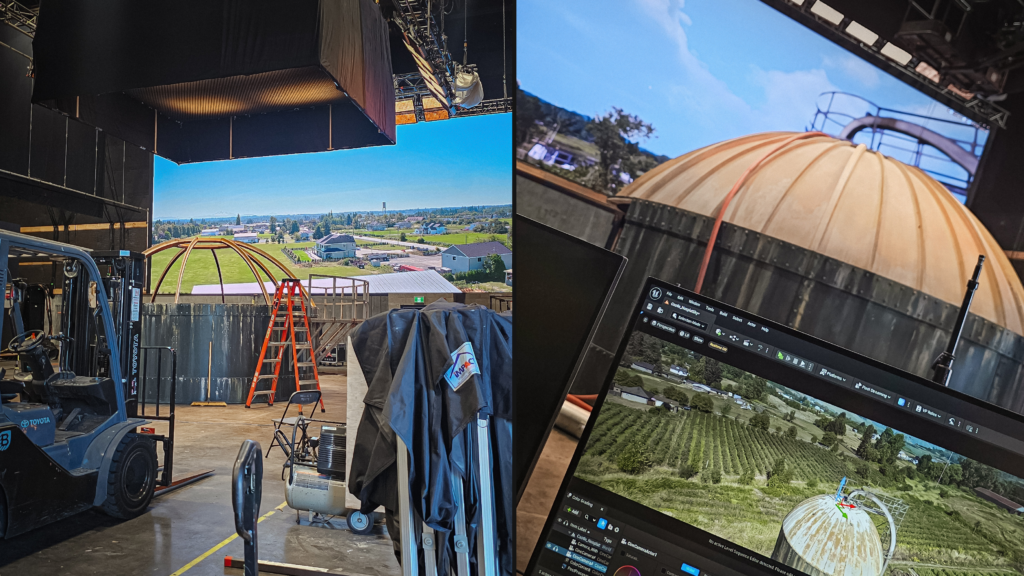
Gaussian splats are quickly moving from experimental R&D conversations into real production pipelines, but for producers, the question is less what is it? and more how do I actually use this on a shoot without breaking my budget, schedule, or pipeline?
We spoke with four practitioners working across virtual production, VFX, and producing to break this down:
Their insights helped shape this guide into a practical handbook for producers evaluating where Gaussian splats fit into modern production workflows.
A Gaussian splat is best understood as a way to capture a real location and turn it into something you can move a camera through later without rebuilding it.
Instead of constructing an environment in CG or recreating it in Unreal, you’re taking a series of images, scans, or video of a real place and converting it into a three-dimensional dataset that preserves how that space actually looks and behaves. That includes not just the layout of the environment, but also the way light falls across surfaces, how reflections shift, and how depth and parallax respond as the camera moves.
From a producer’s perspective, the simplest way to think about it is: it’s like photographing a location once, but capturing enough information that it can be reused later for camera work without returning to rebuild or reshoot the environment.
The key shift is this: with traditional workflows like green screen or CG environments, the world is constructed after capture. With a splat, the captured version of the world becomes the foundation for later camera work.

Having worked across volumetric capture, visual effects, and cinematography, I see Gaussian splats already being used in a few clear ways—bringing real-world environments onto LED volumes, supporting virtual scouting, and accelerating environment creation for VFX without traditional modeling.”
– Kathryn Brillhart, Virtual Production Supervisor / Cinematographer
The virtual scouting function also changes how creative teams collaborate. Rather than requiring everyone to visit a location in person, the splat becomes a shared space the whole team can explore together, on their own time, from anywhere.
Shrinking S3 (Kitchen 3DGS used for reference shots)
Credit: District Cinema (Production Pipeline Solutions) and Digital Film Tree (Post Production)
Producers don’t adopt new workflows because they are innovative. They adopt them because they solve problems in:
For a producer, everything comes down to what is the cost and what is effective. When splats help you achieve your creative goal faster or cheaper, they become a very compelling option.”
– Sarah Ivy, Producer
From a production standpoint, Gaussian splats deliver value across five key areas:
Speed & Cost Efficiency
Gaussian splats significantly speed up environment creation compared to traditional CG builds, allowing production teams to move from capture to usable assets much faster. They also reduce the need for costly location rebuilds and limit reliance on repeated travel to physical sites, which can quickly add up in both time and budget.
Compared to building environments in Unreal, splats can drastically reduce turnaround time—you’re not starting from scratch, you’re working from something real.”
– Barnabas Csutak, Producer / Reality Capture Specialist
Risk Reduction
By capturing physical environments in high detail, Gaussian splats can act as a form of “capture insurance” for unique or hard-to-access locations. This reduces dependency on returning to physical sites for reshoots or pickups and supports stronger continuity planning when additional shots are needed later in production.
Creative Flexibility
This approach opens access to environments that might otherwise be too expensive, logistically complex, or impossible to film. It allows filmmakers and production teams to expand world-building ambitions while staying within tighter budgets, effectively decoupling creative scope from physical production constraints.
Sustainability
With fewer required crew movements and reduced need for repeated location visits, Gaussian splats can help lower the overall environmental footprint of a production. This leads to less travel, fewer logistics demands, and a more efficient on-location workflow.
“For producers, it really comes down to time and risk—splats let you capture a location once and reuse it later, instead of rebuilding it or going back. That alone can save weeks and a significant amount of budget.”
– Barnabas Csutak, Producer / Reality Capture Specialist
Gaussian splats are most effective when production depends on preserving a real location or capturing a set that would be expensive to rebuild for any pick-ups rather than reconstructing or heavily modifying it. They work best when the goal is to capture the exact lighting, texture, and spatial detail of a real environment and reuse it across production stages.
This makes them especially useful for:
In these cases, splats function less like a replacement for CG and more like an efficient method of preserving on-set conditions for reuse.
“What’s interesting to me is how well they preserve both spatial structure and light. When you’re designing a shot—whether it’s a dolly, a handheld move, or even a subtle shift in framing—the way light and reflections change is what makes the space feel real.”
– Kathryn Brillhart, Virtual Production Supervisor / Cinematographer
Splats can also be integrated into scouting, used as safety assets for pickups, or leveraged for reshoots when returning to location is not possible. On productions involving physical risk, that prep function carries even greater weight.
For any kind of stunt work, preparation is critical, not just for efficiency on the day, but for keeping people safe. A splat lets your stunt coordinator, DP, and director prep with real spatial accuracy before filming begins. Everyone shows up knowing the logistics, the sightlines, the constraints. Fewer unknowns, lower risk, safer set.”
– Laura Coover, Director/Producer
While workflows are still evolving, productions are already finding immediate value in splats for planning, continuity, and environment preservation.
Timing is critical. Across all interviews, one theme is consistent: splats must be considered in pre-production—not on set or in post.
Gaussian splats are not a VFX-only decision. They sit at the intersection of multiple departments, which is why early alignment is essential.
Any department that overlaps in both capture and downstream usage needs to be part of the conversation early, because decisions made during acquisition directly affect how the data performs later in the filmmaking workflow. When that alignment happens early, it allows teams to design a capture strategy that supports multiple outcomes, rather than limiting the data to a single use.”
– Kathryn Brillhart, Virtual Production Supervisor / Cinematographer
Departments that should be involved include:
Each role directly influences how the splat will be used downstream.
Why alignment matters:
When alignment happens early, capture can be designed to serve multiple outcomes rather than locking data into a single use case.
One of the most immediate and practical applications for Gaussian splats is not necessarily final-pixel rendering; it’s previsualization. While much of the conversation around splats focuses on virtual production and VFX, many productions are already using them during location scouting, techvis, and creative planning. Instead of relying solely on photos, videos, or walkthroughs, splats allow directors, DPs, production designers, stunt coordinators, and producers to revisit a real environment digitally, preserving the spatial layout, lighting conditions, and camera perspective of the location. This gives teams the ability to continue planning long after the physical scout has ended, even remotely.
For producers, this becomes a major advantage in reducing uncertainty before production begins. Splats can help evaluate blocking, lensing, set dressing, lighting setups, stunt coordination, and scheduling before crews arrive on set. In many cases, the value exists entirely independently from whether the splat is ever used in the final image. Especially for large-scale or international productions, splats are becoming a powerful tool for creative alignment, risk reduction, and smarter pre-production planning.
That shared exploration is invaluable. When the Director, DP, and all department heads have moved through the same space and aligned on the same vision, every decision is more specific, more intentional, and the film is better for it.”
– Laura Coover, Director/Producer
Credit: RCS Studios
Gaussian splat capture is not a passive scan; it is an intentional production process that must be planned and resourced like any other department.
The most critical factor during capture is lighting. Because Gaussian splats preserve real-world conditions, the lighting captured on set becomes embedded into the dataset itself. If that lighting does not align with the intended visual language of the final scene, it can create significant downstream limitations. While it’s relatively easy to transform a softly lit or evenly exposed environment into something darker or moodier using tools like Volinga, it is much more difficult to go in the opposite direction. That’s why capture teams often aim for soft, balanced lighting whenever possible. Direct lighting creates hard shadows that become baked into the scan, and removing or correcting those artifacts later can be extremely resource-intensive.
Time is another key consideration. A quick exploratory scan may take 20–30 minutes, but production-grade captures often require several hours depending on complexity, coverage, and redundancy requirements.
Most productions now use a multi-source approach, combining photography, video, and LiDAR or SLAM based scanning systems, to ensure completeness. Once capture is complete, missing information cannot be reconstructed without compromise.
Fire Country S4 (3DGS used for background)
Credit: RCS Studios
Across interviews, the same issues appear repeatedly:
1. Underestimating capture time
Previs scans are fast. Production-grade captures are not. Coverage, lighting consistency, and redundancy all require more time than expected.
2. Treating splats like traditional polygon-based CG assets
They preserve captured reality, not constructed geometry.
3. Assuming post can fix capture issues
If the data is wrong at capture, those limitations persist through the entire pipeline.
4. Poor lighting planning
Inconsistent or insufficient lighting reduces usability and increases downstream cost.
5. Late decision-making
The later splats are introduced, the less flexible they become.
Many of the common issues during capture come back to a misalignment between what the data is being used for and how it’s being captured. A key question is whether the capture is intended for reference or for production use.”
– Kathryn Brillhart, Virtual Production Supervisor / Cinematographer
Rooster (3DGS used for reshoots & reference shots)
Credit: District Cinema (Production Pipeline Solutions) and Digital Film Tree (Post Production)
Gaussian splats are not simply a new capture format. They represent a shift in how environments are planned, captured, and reused across production pipelines.
For producers, the key shift is timing. The value of splats is determined long before post-production, during planning and capture decisions that shape budget, schedule, and downstream flexibility.
The real advantage is not just efficiency, but optionality: the ability to decide when capturing reality is more effective than rebuilding it, and how that decision shapes the entire production pipeline.
Ultimately, it’s less about replacing existing workflows and more about expanding what’s possible. The tools are evolving quickly, but the opportunity is really in how they allow filmmakers to think differently about space, light, and composition—and to build worlds that aren’t limited by the constraints of a single frame.”
– Kathryn Brillhart, Virtual Production Supervisor / Cinematographer
Credits
Written by:
Carin Mazaira
Contributors:
Kathryn Brillhart
Sarah Ivy
Barnabas Csutak
Laura Coover
Assets:
RCS Studios
District Cinema
Digital Film Tree