Using 3DGS to deliver cinematic realism for Netflix’s Berlin and the Lady with an Ermine
For Berlin and the Lady with an Ermine, Vancouver Media, the team behind Money Heist, set out to create a high-impact nighttime sequence along Madrid’s iconic Calle Alcalá. Led by Director of Photography and Executive Producer Migue Amoedo, the production combined large-scale stunt work with intimate, character-driven moments.
To bring this vision to life, Vancouver Media partnered with Volinga, alongside a virtual production team including Unreal TD Xavier Calvo, Virtual Production Supervisor David Monguet, and VFX Supervisor Gabriel Garrido. Together, they explored how 3D Gaussian Splatting could push the boundaries of realism and flexibility in a complex urban night shoot.
The Creative Vision
From the outset, Migue Amoedo aimed to craft a sequence that felt both cinematic and immersive. The goal was not just to depict motion through Madrid, but to capture the emotional intensity between two characters riding together through the city at night.
This required a careful balance: maintaining the authenticity of a real location while allowing for expressive lighting, dynamic framing, and sustained close-ups that would hold the audience’s attention.
The advantage of Gaussian Splats is that you have complete control over your background and your set. It’s a very desirable work environment.”
– Migue Amoedo, DOP & Executive Producer
The Challenge
The complexity of the sequence came from the need to merge realism with control. As Gabriel Garrido explains, placing two actors in a moving sidecar introduced real physical risk while also demanding an intimate visual approach. The creative intent was to stay close to the actors, capturing their chemistry without compromise, something that is difficult to achieve safely on a live street.
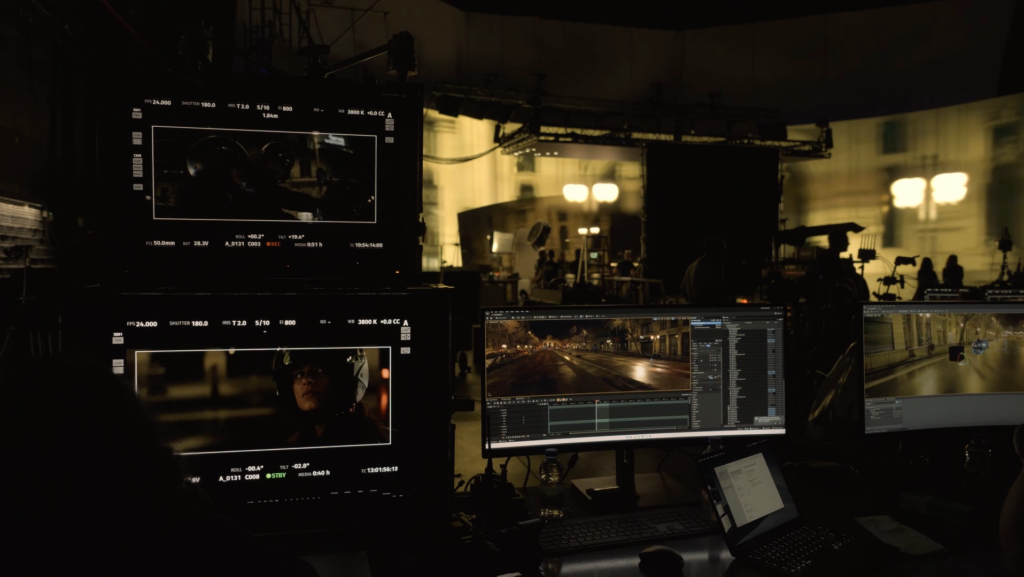
To solve this, the production adopted a hybrid approach: wide shots were captured on location along Calle Alcalá using stunts, while close-ups were filmed on a virtual production stage. However, traditional 2D driving plates quickly proved limiting. Without true depth, they couldn’t provide accurate parallax or perspective, especially given the height difference between the motorcycle rider and the lower-positioned passenger in the sidecar. Camera movement and framing options were restricted, making it difficult to achieve the desired level of realism.
Nighttime conditions added another layer of difficulty. Both the stunt shoot and the background capture had to take place after dark, introducing challenges around lighting, exposure, and dynamic range that would typically complicate both production and postproduction workflows.
The Solution: Capturing Madrid in 3D
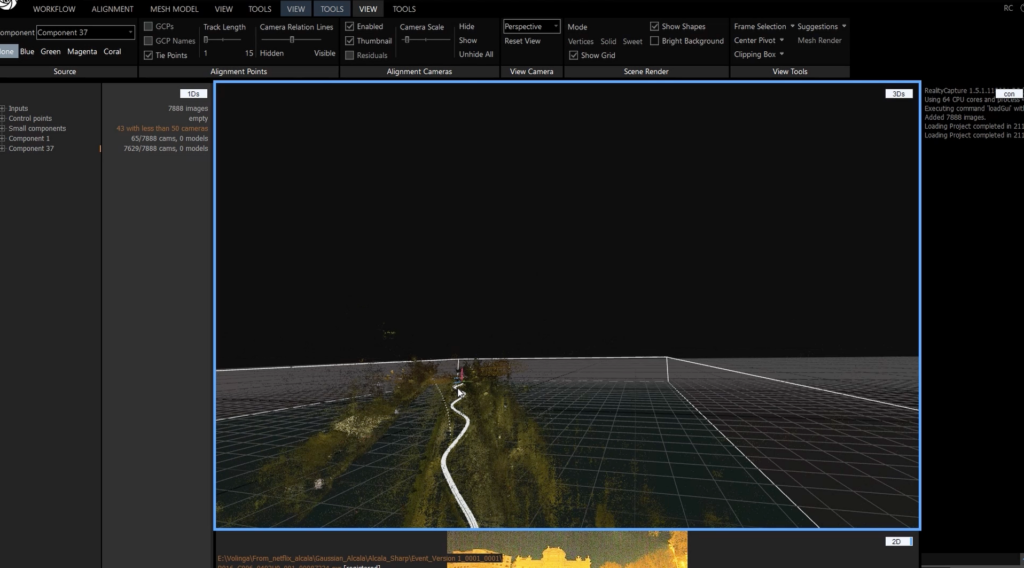
To overcome these challenges, the full environment of Calle Alcalá was captured using a multi-camera rig mounted to a moving vehicle. While the process resembled a traditional driving plate shoot, the outcome was fundamentally different. The capture was converted into a sequence of Open EXR files that were used to process the 3DGS model. Using Volinga Suite’s HDR ACES workflow, the team was able to capture a significantly wider range of visual information, essential for a complex nighttime environment.
This approach addressed two critical production challenges. First, the high dynamic range ensured that both the darkest areas of the scene and the brightest light sources, such as streetlights and practicals, were captured with full detail, avoiding the typical loss of information in low-light conditions. Second, the expanded color data proved essential for accurately matching the virtual production footage with the on-location stunt shots, ensuring seamless visual continuity across the sequence.
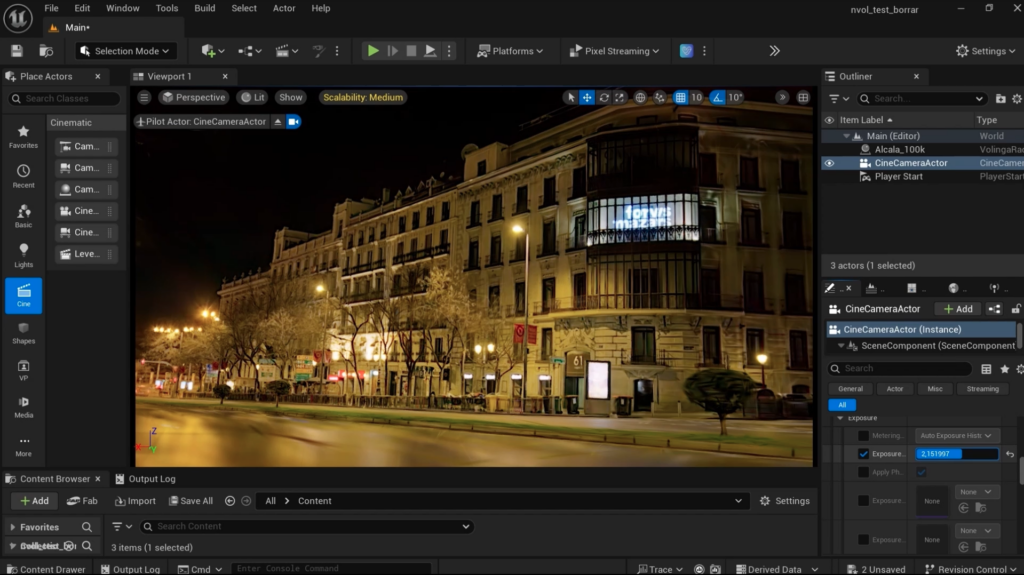
Rather than producing flat footage, the captured data was reconstructed into a 3D Gaussian Splat, creating a volumetric representation of the real-world location. This allowed the production to move freely within the scene, with natural parallax and accurate perspective from any camera position. Once integrated into Unreal Engine and displayed on an LED volume, the environment became a fully interactive backdrop for filming close-up performances.
With the team at MO&MO, the Gaussian splat was brought into Unreal Engine and displayed on an LED volume using the Volinga Plugin for UE, enabling the team to shoot close-up performances with a realistic, responsive background.
The result was a hybrid workflow where Gaussian Splatting and driving plates were used together seamlessly, with no visible distinction in the final edit. Crucially, the final sequence is seamless. The audience cannot distinguish between the techniques.
Why Gaussian Splatting
Gaussian Splatting proved particularly valuable for this production because it addressed the core limitations of traditional techniques while remaining efficient to deploy. By reconstructing the environment in 3D, it provided the depth and flexibility required for complex camera setups, especially in a scene involving multiple character heights and dynamic movement.
The main advantage is the speed at which scenes can be generated. With Gaussian techniques, the time required to create assets is much shorter.”
– Xavier Calvo, Unreal Environment Artist
This enabled the team to move faster while maintaining cinematic quality, particularly critical for complex urban environments.
The Result
The final sequence delivered highly realistic, cinematic close-ups that matched seamlessly with on-location stunt footage. Key advantages included:
Natural reflections on helmets and vehicles
Integrated lighting and lens flares captured in-camera
Consistent visual continuity across all shots
This is where quality and efficiency come together. The quality comes from the nuances you get with an ICVFX shoot. In terms of efficiency, the difference was huge: the motorbike take went straight to the edit; there was no postproduction at all.”
– Gabriel Garrido, VFX Supervisor
This integration had a significant impact on efficiency as well. Rather than requiring extensive compositing or reconstruction in postproduction, the footage was ready immediately for editorial.
Production Benefits
One of the most notable advantages emerged in how the production handled lighting continuity. During the stunt shoot, the city lights along Calle Alcalá were fully illuminated. However, by the time the environment was captured later that night, those lights had been turned off, creating a mismatch that would traditionally require significant postproduction work to resolve.
With the Volinga’s Unreal Engine plugin relighting tool, the team was able to make subtle adjustments directly within the environment, balancing highlights and lifting shadows without breaking realism. This allowed them to maintain continuity with the original footage while preserving the natural look of the scene.
The ability to make these adjustments in real time not only reduced postproduction demands, but also enabled faster, more confident decision-making on set.
Key Takeaways
This project demonstrates how 3D Gaussian Splatting can fundamentally expand what is possible in virtual production. Some key takeaways included:
3D Gaussian Splats provide depth and parallax essential for complex camera setups
HDR capture enables high-quality results even in low-light environments
Real-time adjustments in Unreal Engine reduce postproduction workload
Hybrid workflows allow teams to combine traditional and emerging techniques seamlessly
This isn’t about technology. It’s about approach. If you’re creative, you start finding shoot solutions you wouldn’t have even considered before.”
– Gabriel Garrido, VFX Supervisor
A New Approach to Storytelling
For Vancouver Media, this project represents a broader shift in how stories can be developed and executed. By capturing real-world environments and bringing them into a controlled production space, filmmakers gain the ability to balance safety, efficiency, and creative ambition in new ways.
This approach not only reduces the logistical challenges of location shooting, but also opens the door to more experimental and ambitious storytelling.
Splats give us the opportunity to write more original stories and explore narratives you normally couldn’t even imagine.”
– Migue Amoedo, DOP & Executive Producer
Watch Berlin and the Lady with an Ermine on Netflix to see the results in action (Episode 1 Minute 32:20).
Credits
Production: Netflix’s Berlin and the Lady with an Ermine
Production Company: Vancouver Media (Money Heist / La Casa de Papel)