
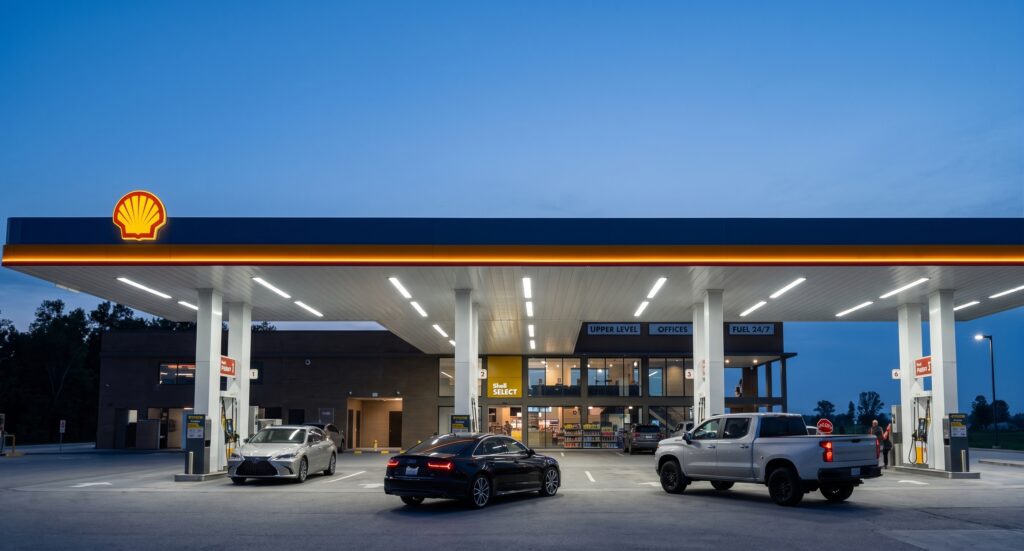
For a major advertising campaign for Shell Argentina tied to the Football World Cup, Lionel Scaloni and Mirtha Legrand were brought together as the campaign’s featured talent. With two of Argentina’s most recognizable public figures attached, the production required a workflow capable of delivering high visual quality under significant scheduling constraints.
To solve this challenge, Cacodelphia Studios used Volinga to capture and transform a real Shell service station into a production-ready virtual environment using Gaussian Splat technology, bringing the location into the studio and onto an LED stage for a faster, more flexible production workflow.
One of the campaign’s key scenes was designed to take place inside a real Shell service station. While the creative team wanted the realism and brand familiarity of the physical location, filming on-site introduced several production challenges.
Transporting high-profile talent, coordinating crew logistics, managing location access, and working around operational restrictions would have significantly increased complexity and risk. Additionally, outdoor shooting conditions would have introduced variables such as weather dependency and inconsistent lighting conditions.
With limited time available from the featured talent, production efficiency became critical.
The team needed a way to preserve the authenticity of the real-world location while bringing it into a controlled production environment.
Using Volinga’s Gaussian Splat technology, the team captured an existing Shell station and converted it into a highly realistic virtual environment.
Rather than rebuilding the location through traditional 3D modeling, the production began with a real-world capture that retained the spatial detail, textures, and imperfections of the original environment.
This allowed the entire scene to be moved into Cacodelphia Studios’ LED stage pipeline, eliminating the need for talent and crew to travel to the physical location.
The result was a hybrid production workflow that combined the realism of a real location with the control and flexibility of virtual production.
Volinga allowed us to bridge the gap between real-world locations and virtual production with remarkable speed and realism. Rather than treating the scan as a fixed background, we were able to transform it into a true filmmaking environment—removing elements, adding new assets, and redesigning the lighting according to the creative needs of the campaign. This gave us the authenticity of a real Shell service station together with the control and efficiency of shooting on our LED stage.”
– Gastón Gallo, Founder & Virtual Production Director, Cacodelphia Studios
1. Location Capture
The Cacodelphia location capture team surveyed and captured the physical Shell service station, generating the source material needed for digital reconstruction. This formed the foundation of the virtual environment.
2. Environment Processing & Creative Adaptation
The Virtual Art Department processed and optimized the captured environment using Volinga. Unlike traditional scans that often function as static assets, this environment became a flexible creative foundation. Using Volinga’s Unreal Engine tools, the team removed unwanted elements from the original location, introduced additional 3D assets, adjusted the composition, and reworked the environment to align with the campaign’s creative vision.
3. Relighting for Cinematic Control
One of Volinga’s most valuable contributions to the project was the ability to relight the captured environment. Traditional scans usually retain the lighting conditions present during capture, limiting flexibility during production. For this campaign, however, the environment needed to adapt to the cinematographic requirements of the shoot.
Volinga allowed the team to significantly alter the lighting setup, enabling closer alignment between the virtual lighting inside Unreal Engine and the physical lighting on the LED stage. This created a more natural integration between the performers, practical foreground elements, and the digital environment.
4. LED Stage Production
Once integrated into Unreal Engine, the virtual production team configured the real-time environment for the final LED-stage shoot inside Cacodelphia Studios. This gave the director and cinematographer full control over timing, camera movement, lighting, and scene composition in a controlled studio environment.
Gaussian Splat technology gave the team a faster path from real-world location capture to production-ready environment. Achieving the same result through a traditional 3D workflow would have required a more time-intensive process involving photogrammetry, manual modeling, texturing, shading, lighting, and optimization.
By starting from a real-world capture, the team was able to preserve the realism and complexity of the Shell station while reducing the amount of manual asset development required. This allowed the production team to focus more on creative adaptation and cinematography rather than rebuilding an environment from scratch.
The most significant outcome of the project was the reduction in environment-development time and on-set logistical complexity. By capturing and digitizing the Shell station instead of building it from scratch, the team eliminated a substantial amount of manual production work and accelerated the environment-development process.
The virtual production approach also removed the need to transport talent, crew, and technical infrastructure to the physical location, reducing travel costs, minimizing operational risks, and maximizing the limited availability of the campaign’s featured personalities.
Most importantly, these efficiencies were achieved without sacrificing realism. The final environment preserved the visual authenticity of the original Shell location while providing significantly more control over lighting, timing, and shooting conditions.
For Cacodelphia Studios, the highlight of the project was proving that Gaussian Splat technology is more than a visualization tool. By integrating Volinga into a professional virtual production workflow, the team demonstrated how real-world environments can become flexible filmmaking assets: fully modifiable, relightable, and ready for real-time production.
This project showcased how Gaussian Splats can bridge the gap between physical locations and virtual production with unprecedented speed, realism, and creative freedom.
Credits
Cacodelphia Studios: Provided the complete virtual production workflow, from location capture to final LED-stage shoot