Using 3D Gaussian Splatting for Episodic Virtual Production
Reconstructing a Real Environment for Fire Country (Season 4, Episode 4)
Virtual production workflows built around LED wall stages have become increasingly common in film and television. But the way environments are created for those stages hasn’t always kept up. Traditional asset pipelines — environment modeling, texturing, lighting — can take weeks. For episodic television, where schedules are tight and turnaround is everything, that kind of timeline is often impractical.
This case study looks at how 3D Gaussian Splatting (3DGS) was used to reconstruct a real-world location and deploy it as a stage-ready LED wall environment for Fire Country — Season 4, Episode 4, produced by CBS / Paramount.
The scene called for characters to appear at the top of a silo, looking out over the surrounding landscape. Filming at the real location would have introduced significant logistical and safety concerns — camera placement at height, crew access, and the difficulty of repeating takes in those conditions.
The production chose instead to build the top of the silo as a physical set piece inside a controlled stage environment, with an LED wall providing the surrounding landscape. The question was how to get that landscape into the stage quickly and at a quality level that would hold up on screen.
Capturing the Location
The environment reconstruction was handled by RCS Studios, who served as the Virtual Art Department (VAD) for the project. The process began with aerial drone capture of the real location, recording the surrounding landscape from the perspectives needed to reconstruct the environment accurately.
The captured dataset was then processed into a 3DGS reconstruction, producing a detailed, photorealistic representation of the real-world environment.
This drone-to-splat pipeline gave the team a usable 3D environment without the modeling, retopology, UV mapping, and lookdev cycles that a traditional asset build would require.
Preparing the Environment in Unreal Engine
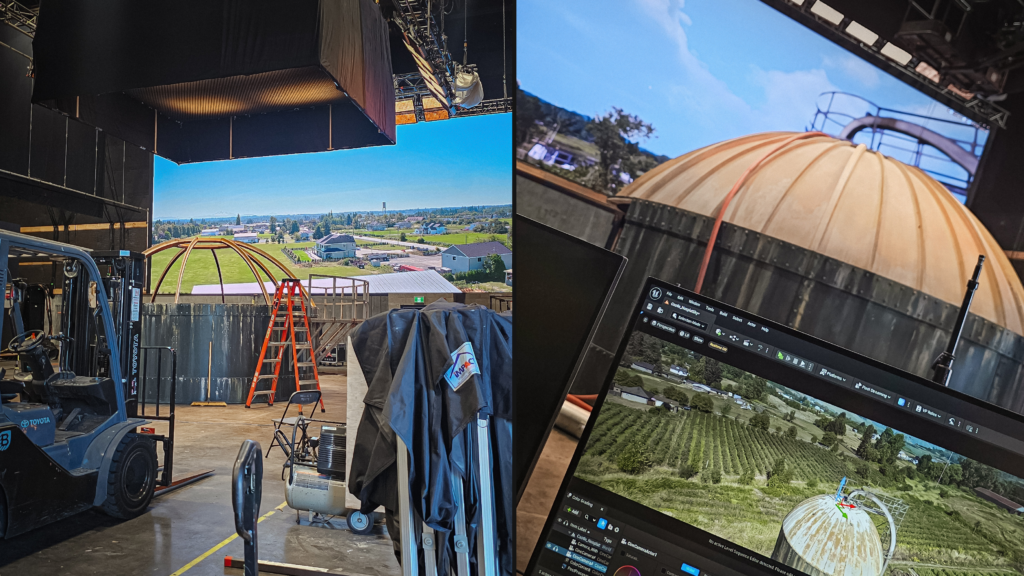
Once reconstructed, the Gaussian Splat environment was imported into Unreal Engine. Using Volinga’s Gaussian-based tools, the VAD team at RCS Studios could edit and optimize the reconstruction directly inside the real-time environment.
This included:
Removing unwanted elements from the captured scene
Adjusting sky and atmospheric conditions
Relighting the environment to match cinematography requirements
Preparing the final output for LED wall display
Because the reconstruction existed as a real-time scene inside Unreal Engine, all of these adjustments could be made quickly — without rebuilding the environment from traditional assets.
That kind of flexibility is particularly valuable when you’re working within the compressed schedules of episodic television.
“Real-time rendering always comes with hardware limitations, especially when running nDisplay. Gaussian Splats push that boundary further than traditional 3D can, letting you reach a higher level of realism within the same hardware constraints. Volinga has proven to be the most flexible and performant Gaussian Splatting plugin we’ve used in Unreal Engine.”
– Lukas Benites, Head of Virtual Production, RCS Studios
On the LED Wall Stage
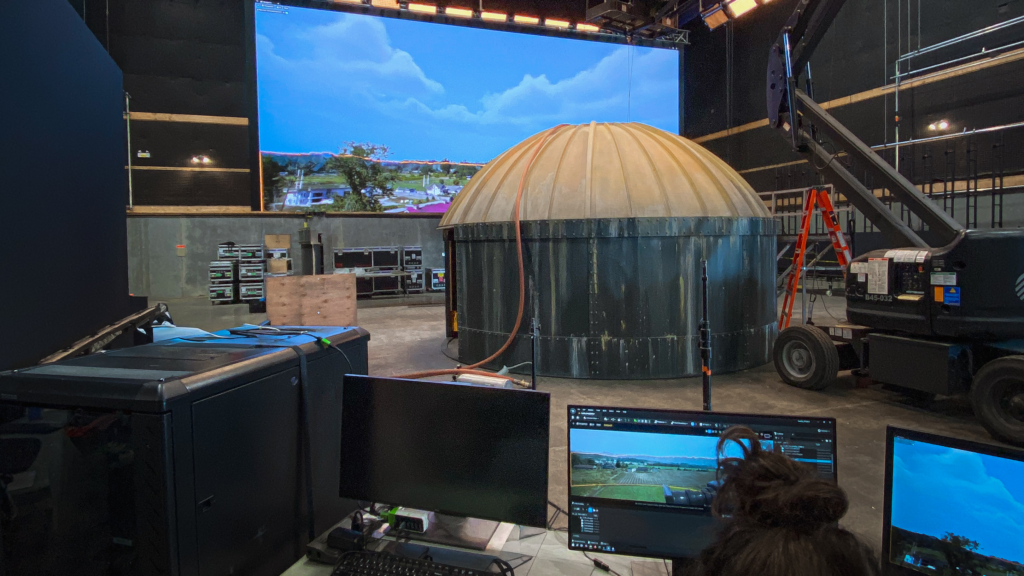
With the environment prepared, it was deployed to the LED stage for filming. The reconstructed landscape served as the background displayed on the LED wall, surrounding the physical set piece representing the top of the silo. Actors and camera teams could work safely at ground level while maintaining the full visual context of the real location.
Beyond the background environment, the reconstruction also included the silo structure itself. Having the real silo available as a 3D model inside Unreal Engine allowed the team to toggle it on and off during setup, using it as a reference for camera alignment between the physical set and the virtual environment. This made it significantly easier to match perspectives and ensure the LED wall content lined up correctly with the practical foreground.
Scarab Digital provided the playback infrastructure for the LED wall stage, supporting the hardware systems and on-set operation that kept the environment running reliably throughout production.
“Volinga’s Unreal pipeline made it possible to bring a captured real-world environment into Unreal in a way that remained highly performant and practical for production. For the CBS Series Fire Country silo sequence, we commissioned a Gaussian capture of the real location so we could represent the environment accurately on the LED volume in real time — keeping actors safely on stage and avoiding the need for bluescreen and traditional CG reconstruction. For productions exploring Gaussian environments in virtual production, that speed and responsiveness are incredibly valuable.”
– Danny Ho, Playback | Virtual Production Supervisor, Scarab Digital
Real-Time Feedback on Set
One of the most significant advantages of this approach was the ability to see real lighting and color interactions directly on set, rather than waiting for post-production to evaluate the final look.
“Having real-time feedback of light and color onto my set is a huge benefit to understand how it all ties together with other post workflows, and it is also invaluable for the actors to have something to act against.”
– Henrique Reginato, On-Set VFX Supervisor
That immediacy — seeing the environment respond to practical lighting in real time — allowed the production team to make creative decisions on the spot, with confidence in how the final image would come together.
The Final Shot
The resulting in-camera image combined the physical foreground set, the actors and practical lighting, and the reconstructed Gaussian Splat environment displayed in real time on the LED wall. No extensive compositing required. The shot was captured directly during filming.
Why This Matters for Episodic Television
While Gaussian-based reconstruction has been gaining traction in research and experimental workflows, its use in real broadcast production environments — particularly in episodic television — is still relatively new.
This project on Fire Country demonstrates that 3DGS can work within a real production pipeline, offering:
Rapid reconstruction of real environments through drone-based capture
Real-time editing and relighting inside Unreal Engine
Significantly faster preparation of LED wall environments compared to traditional asset builds
For productions operating under the kind of tight schedules that episodic television demands, this type of workflow offers a practical path to bringing real-world locations onto the LED stage without the overhead of traditional environment creation.
Projects like this suggest that Gaussian-based reconstruction is ready to play a meaningful role in virtual production — not as a replacement for traditional pipelines, but as a powerful complement where speed and flexibility are critical.
Credits
Virtual Art Department (VAD): RCS Studios Playback & On-Set Hardware Operation: Scarab Digital Production: Fire Country – Season 4, Episode 4 (CBS/Paramount)