Transforming a Film Scene Into an Interactive Gaming Experience with 3DGS
What if watching a film didn’t have to end when the credits rolled? What if, instead, you could step through the screen and explore the world you had just been watching?
That question was at the heart of MetaUmbra, an interactive horror proof of concept from PortalScope Studios exploring the space between cinematic storytelling and gameplay.
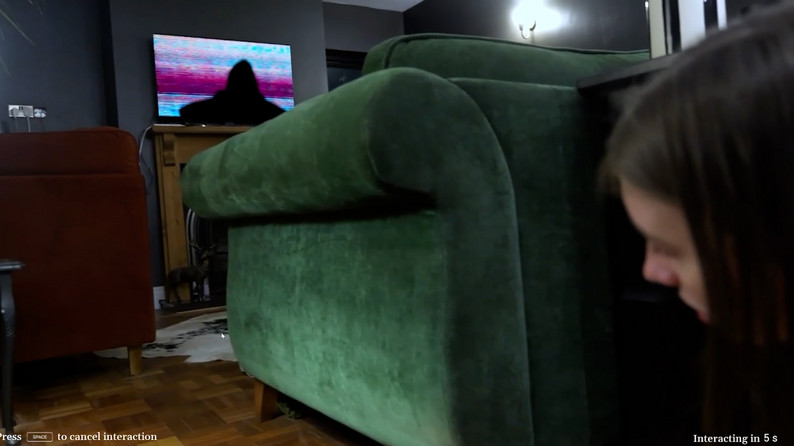
The experience begins as a live-action short film. Lola is alone in a house when something emerges from the static of her television. But instead of ending with the cinematic, MetaUmbra gives the audience control. The viewer can step into the same environment, explore the room, interact with objects, and attempt to survive the entity.
The goal was simple to describe, but technically ambitious: Could a viewer move from watching a movie to playing a game without leaving the world of the film?
For MetaUmbra, the answer became a working prototype.
We realized you could actually transition from watching a movie to becoming the character and experiencing that world for yourself. That was the idea we wanted to prove with MetaUmbra.”
– Peter Butler, Founder, PortalScope Studios
The result is a hybrid experience in which the movie and the game exist together inside a single Unreal Engine application.
Why Gaussian Splatting?
For PortalScope, Gaussian Splatting offered two major advantages: preserving the look of the filmed environment and reducing the need for traditional reconstruction.
Traditional game development can require a real location to be photographed, modeled, textured, and optimized before it becomes a digital environment. Even with significant effort, the result remains a reconstruction of the original.
Gaussian Splatting offered a different approach. Instead of rebuilding the room from references, PortalScope could capture the environment itself and bring that captured appearance into the interactive experience.
For MetaUmbra, that visual continuity was critical. The interactive environment needed to feel like the same place the audience had just seen in the film, not a separately modeled approximation.
With traditional 3D modeling, recreating this environment to the same level of realism could take weeks or even months, and you still wouldn’t be close to what it actually looked like. With Gaussian Splatting, we could capture the real environment and preserve the look of the film.”
– Peter Butler, Founder, PortalScope Studios
From Gaussian Splat to Playable Experience
Capturing the environment was only the first step. To become a playable experience, the Gaussian Splat needed to function inside the same Unreal Engine application as the rest of the game.
PortalScope used the Volinga Unreal Engine plugin to bring the captured environment into Unreal. Players don’t launch Volinga separately; the technology is integrated into the Unreal-based application, allowing the Gaussian environment to function as part of the game itself.
For PortalScope, this was critical to moving MetaUmbra beyond a technical demonstration and into a distributable, playable experience.
One of the biggest questions was whether we could actually distribute this experience to players. We needed the Gaussian Splat to work inside the Unreal game itself, and Volinga made that possible. Without that, we couldn’t have delivered the experience we wanted.”
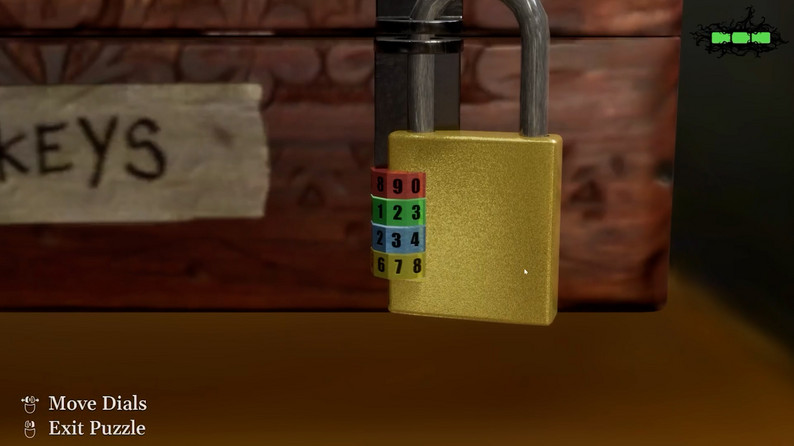
Once the Gaussian Splat was inside Unreal, the team needed to build everything around it that makes a game interactive. That included:
Interactive objects
UI elements
Object highlighting
Audio and music
Enemy behavior
Visual effects
Smoke effects
Player interaction
Gameplay mechanics
The team also had to determine how those systems would work alongside the captured environment.
A game is much more than the environment. You have the UI, sound, music, interactions, visual effects and everything else that makes the experience feel alive. Figuring out how all of those elements could work together with a Gaussian Splat was one of the most interesting parts of the project.”
For example, interactive objects needed to be highlighted, while visual effects could be triggered as the entity approached the player.
From Film to Playable World
At the center of MetaUmbra is the moment when the audience stops being a spectator and becomes a player. The film establishes the story, character, and environment through live action. As the supernatural event unfolds, the experience transitions into the captured 3D environment. The audience can then move around the same room they were just watching on screen.
Instead of moving from a film into an unrelated game level, the player enters a digital representation of the world they have just experienced. The result is a single experience in which cinema establishes the world and gameplay gives the audience agency within it.
For PortalScope, that approach points toward a new way of thinking about interactive storytelling. A physical location can be filmed for a cinematic experience and then captured for an interactive one. Rather than rebuilding that location from scratch, the captured environment can become the foundation for gameplay.
Looking Ahead
MetaUmbra was never intended to be the final version of the idea. The project is a standalone technical proof of concept and a “mood piece” for PortalScope’s upcoming folk-horror feature film, The Rackajack.
Its purpose was to explore what could happen when filmmaking, Gaussian Splatting, and real-time gameplay are brought together.
For PortalScope, the larger vision is to create experiences in which stories don’t necessarily end when the film ends. Instead, audiences could enter the world, explore it, and experience it from a new perspective.
MetaUmbra is a working prototype designed to explore what is possible. In some ways, that’s what makes it exciting. It shows the potential of combining filmmaking, Gaussian Splatting and gameplay in completely new ways.”
– Peter Butler, Founder, PortalScope Studios
The prototype demonstrates that the boundary between cinema and games doesn’t necessarily have to be a hard line. A filmed world can become a playable world.
Credits
PortalScope Studios Peter Butler, Founder Lloyd Wright, Technical Lead